
Where are the lines drawn?
Those who have the redistricting pen don’t have a blank slate for drawing the lines. Various rules limit where district lines may or may not be drawn. Rules about equal population and minority voting rights have federal backing (though states may add additional constraints). But even after accounting for the federal rules, there are countless ways to divide a jurisdiction into districts. State constitutions — and sometimes, state statutes — provide a few additional rules for drawing the lines.
Occasionally, states list these constraints in priority order, and expressly require satisfying high-priority criteria before turning to the others. More often, though, the principles below are simply presented without express priorities, and with instructions to follow them “where practicable.” When that happens, the entity drawing the lines has the discretion to take criteria into account, and resolve conflicts where they arise, as it sees fit.
Equal population
The U.S. Constitution requires that each district have about the same population: each federal district within a state must have about the same number of people, each state district within a state must have about the same number of people, and each local district within its jurisdiction must have about the same number of people.
- Congressional districts. The standard for congressional districts allows relatively small deviations, when deployed in the service of legitimate objectives. States must make a good-faith effort to draw districts with the same number of people in each district within the state, and any district with more or fewer people than the average must be justified by a consistent state policy. But consistent policies that leave a relatively small spread from largest to smallest district will likely be constitutional. In 2012, for example, the Supreme Court approved a congressional plan in West Virginia with 0.79% population variation based on keeping county lines intact.
These population counts are calculated based on the total number of people in each state, including children, noncitizens, and others not eligible to vote. After the Civil War, we amended the Constitution to ensure that each and every individual present in the country would be represented in federal districts. On July 21, 2020, President Trump purported to suggest that he had the authority to exclude undocumented individuals from the census count — if valid, that would have affected not only how many districts the states got, but how those districts were divided within a state. Litigation over the issue hit procedural hurdles as it was unclear whether the data would be ready in time for President Trump to make the determination he’d flagged; ultimately, the data were delayed long enough for the Biden Administration to reverse course. As in prior decades, the Census counts will include everyone for purposes of apportionment.
- State and local legislative districts have a bit more flexibility on the numbers; they have to be “substantially” equal. Over a series of cases, it has become accepted that a plan will be constitutionally suspect if the largest and smallest districts are more than ten percent apart. This is not a hard line: a state plan may be upheld if there is a compelling reason for a larger disparity, and a state plan may be struck down if a smaller disparity is not justified by a good reason.
Some states hold their state districts to stricter population equality limits than the federal constitution requires. Colorado, for example, allows at most five percent total deviation between the largest and smallest districts; Missouri asks districts to be no more than one percent above or below the average, except that deviations of up to three percent are permitted to maintain political boundaries. Iowa both limits the total population deviation to five percent, and also sets the overall average deviation at no more than one percent.
As far as who is counted for purpose of equalizing state and local districts, the Supreme Court has been less definitive about what the Constitution requires. In 2011, each and every state counted the total population. But some have suggested other measures, including voting-age population (“VAP”), citizen voting-age population (“CVAP”), or registered voters. Each of these alternatives depends on a logic of exclusion, denying representation to those who pay taxes and who are expected to live by our laws. Though the Supreme Court has formally left this question for a future case, their last word in the area left serious question as to whether such measures would be constitutional.
Minority representation
The other set of major federal redistricting rules concerns race and ethnicity. The extent to which redistricting can or must account for race and ethnicity is sometimes seen as a particularly thorny problem, but that’s in part because some people have a vested interest in making it seem hard. Race relations and electoral politics are both quite complicated. But the law on race and ethnicity in the redistricting context essentially boils down to three concepts. And while there are without question some complications in the details — including some hurdles for challengers trying to challenge maps in court — the overview for those drawing the lines is pretty straightforward.
- Don’t draw lines that set out to harm voters based on their race or ethnicity.
- Where discrimination plays or has played a significant role, and where voting is substantially polarized along racial or ethnic lines, look at electoral patterns and decide whether minorities already have proportionate electoral power. If not, the Voting Rights Act might require a change to the lines to give a compact and sizable minority community equitable electoral opportunity they do not currently enjoy.
- When considering race in drawing districts, whether to satisfy the Voting Rights Act or otherwise, consider other factors in the mix as well.
- Intentional discrimination. For more than 100 years, the Constitution has prohibited intentional government efforts to treat similarly situated people worse than others, because of their race or ethnicity. In redistricting, one ploy is called “cracking“: splintering minority populations into small pieces across several districts, so that a big group ends up with a very little chance to impact any single election. Another tactic is called “packing“: pushing as many minority voters as possible into a few super-concentrated districts, and draining the population’s voting power from anywhere else. Other tactics abound. And they have been used with disappointing frequency. Redistricting legislation usually just describes which census blocks fall in which districts, or which streets district lines follow: nothing in a redistricting statute looks like it has anything to do with race. But if the line-drawers intentionally drew the lines to harm residents specifically because of their race, that’s almost always illegal.
That remains true no matter the underlying motive for the discrimination. Sometimes, the reason for intentional discrimination is old-fashioned hatred or stereotype. But singling out racial minorities for worse treatment because of the candidates or parties they prefer still involves singling out racial minorities for worse treatment. And it still invites particularly close scrutiny under the constitution.
- Voting Rights Act. The federal Voting Rights Act of 1965 was designed to combat tactics denying minorities the right to an effective vote, including redistricting techniques like those above. As federal law, the Voting Rights Act overrides inconsistent state laws, just like the constitutional equal population rule overrides other state laws. From 1965-2013, the Voting Rights Act had an especially powerful provision targeting the jurisdictions with the worst history of discrimination. In these areas, the Voting Rights Act required every change in election rules to be run by the Department of Justice or a federal court before they took effect, stopping discrimination before it had the chance to work. In 2006, Congress last revisited the part of the statute designating which jurisdictions should be covered. But in 2013, the Supreme Court decided in Shelby County v. Holder that this 2006 renewal was not sufficiently tied to current conditions; their decision striking down the coverage provision essentially left no jurisdictions covered. In 2019, the House of Representatives passed a new coverage provision, but it did not proceed through the Senate. After Shelby County, the most powerful remaining provision of the Voting Rights Act is Section 2 of the Act, which blocks district lines that deny minority voters an equal opportunity “to participate in the political process and to elect representatives of their choice.” It applies whether the denial is intentional, or an unintended end result. Courts essentially test whether the way that districts are drawn takes decisive political power away from a cohesive minority bloc otherwise at risk for discrimination. There are three threshold conditions for a court finding that districts need to be redrawn because section 2 has been violated. (These are often called Gingles conditions, after the Supreme court’s Thornburg v. Gingles case.) The first asks whether it is possible to draw a district so that a majority of voters belong to a geographically “compact” racial, ethnic, or language minority community. Compactness has never been precisely defined in this context, but generally refers to populations that are not particularly “far-flung,” and where the boundaries are fairly regular, without extensive tendrils. This first Gingles condition basically tests whether a sufficiently large minority population is geographically distributed so that they could control a reasonable district. The second Gingles condition tests whether the minority population usually votes as a bloc, for the same type of candidate. This is a nuanced test: not whether the community usually votes for Democrats or Republicans (or others), but whether they would, given a fair mix of candidates, vote for the same type of Democrats or Republicans (or others).The third Gingles condition tests the potential competition: whether the rest of the population in the area usually votes as a bloc for different candidates than those preferred by the minority community. If so, this would mean that the minority’s preferred candidate would almost always lose — if the minority community’s voting power were not specifically protected. Together, the second and third conditions are known generally as “racially polarized” voting. If the three threshold conditions above have been met, courts then look to the “totality of the circumstances” to determine whether the minority vote has been diluted, drawing from the U.S. Senate’s legislative report when the Voting Rights Act was passed. Most of these circumstances relate to the extent of historical or contextual discrimination. One factor that has been singled out as particularly important is rough proportionality: whether minorities have the opportunity to elect representatives of their choice in a number of districts roughly proportional to the percentage of minority voters in the population as a whole. Section 2 does not guarantee proportionality. But if a minority group with 20% of a state’s eligible population could already elect representatives in 20% of the state’s districts, courts will be more hesitant to find a violation of section 2 even if the three Gingles conditions are met. And if the minority group does not have such an opportunity, courts will often be more prone to find a violation. Courts have largely articulated Section 2’s meaning after plans have been drawn and challenged, and so the tests above are framed retroactively. For those drawing the lines and seeking to avoid legal trouble, the usual technique involves protecting substantial minority populations in racially polarized areas, by drawing district lines so that those minorities have the functional opportunity to elect a representative of their choice.
- Considering other factors. The Supreme Court has also said that the Constitution requires it to look skeptically at redistricting plans when race or ethnicity is the “predominant” reason for putting a significant number of people in or out of a district. This does not mean that race can’t be considered, or that when districts drawn primarily based on race are invalid. It means that there has to be a really good reason for subordinating all other districting considerations to race. (And the Court has also repeatedly implied that one such compelling reason is compliance with the federal Voting Rights Act.) In practice, this means that those drawing the lines try not to let racial considerations “predominate,” by considering other factors at the same time. This is not terribly difficult; there are lots of other considerations that go into deciding where to draw a particular district line, like the residential clustering of groups of voters with common interests, or the locations of municipal boundaries or physical geographic features, or the desire to keep a district relatively close together. It may be useful to think of this rule like most of us think about driving a car. It’s important to keep to the speed limit. If you obsess over your speed, and stare only at the speedometer, subordinating every other stimulus, you’re likely to crash. But if you pay attention to the road, and surrounding traffic, and the directions to your destination, and signaling when you change lanes, and the car temperature, and the amount of gas you’ve got left, and the weather, and the music on the radio — and also check in on your speed from time to time — then your attention to the speed doesn’t “predominate.”
Contiguity
Contiguity is the most common rule imposed by the states: by state constitution or statute, 45 states require at least one chamber’s state legislative districts to be contiguous. 18 states have similarly declared that their congressional districts will be contiguous. (The smaller number reflects the fact that few states have any express legal constraints on congressional districting. In practice, the vast majority of congressional districts — perhaps every one in the 2020 cycle — will be drawn to be contiguous.)
A district is contiguous if you can travel from any point in the district to any other point in the district without crossing the district’s boundary. Put differently, all portions of the district are physically adjacent. Most states require portions of a district to be connected by more than a single point, but don’t further require that a district be connected by territory of a certain area.
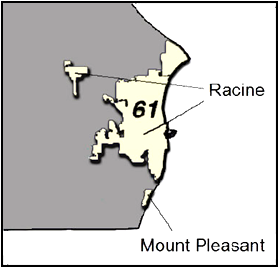
Few redistricting concepts are absolute, and contiguity is no exception. Many states require contiguity only “to the extent possible,” and courts generally accept anomalies that otherwise seem reasonable in context. For example, the city of Racine, Wisconsin, has a non-contiguous boundary (boundaries like this are fairly common by-products of annexation). And so, in 2001, the legislature drew Wisconsin’s 61st state assembly district to incorporate most of the city of Racine — with a noncontiguous portion of the district embracing the noncontiguous portion of the city. In 2011, Wisconsin’s 47th state assembly district did much the same for the noncontiguous portions of Blooming Grove and several other noncontiguous wards, and the 60th state assembly district did the same for the noncontiguous portions of Cedarburg.
Water also gets special treatment for contiguity. In most cases, districts divided by water are contiguous if a common means of transport (like a bridge or ferry route) connects the two sides of the district. Island districts are generally contiguous as long as the island is part of the same district as the mainland area closest to the island or most tied to the island by these sorts of transport routes. In Hawaii, where there is no mainland to consider, the state constitution prohibits the drawing of “canoe districts” — districts that are spread across more than one major island group, where it is necessary to use a “canoe” to travel between different parts of the district.
Political boundaries
The next most common state rule is a requirement to follow political boundaries, like county, city, town, or ward lines, when drawing districts. By state constitution or statute, 34 states require state legislative districts to show some accounting for political boundaries; 15 states impose similar constraints on congressional districts. Most often, state law concerning political boundaries leaves a fair amount of flexibility in the mandate — one common instruction is to keep to political boundaries “to the extent practicable.” And like all other state redistricting law, this rule must bend where necessary to federal equal population or Voting Rights Act constraints.
It is worth remembering that some cities or towns spill over county lines; even though counties are usually bigger than cities, keeping strictly to county lines may mean cutting off pieces of these “spillover” cities or metropolitan areas.
Also, if counties or cities have to be split to comply with other redistricting requirements, most state law does not specify whether it is better to minimize the number of jurisdictions that are split, or to minimize the number of times that a given jurisdiction is split. The former might mean splitting a few jurisdictions into many pieces; the latter might mean splitting a greater number of jurisdictions, but into fewer pieces. (As an exception to the general flexibility, Ohio has a rather detailed set of constraints describing how counties and other municipalities are to be split if they have to be split at all.)
Compactness
Almost as often as state law asks districts to follow political boundaries, it asks that districts be “compact.” By constitution or statute, 32 states require their legislative districts to be reasonably compact; 17 states require congressional districts to be compact as well.
Few states define precisely what “compactness” means, but a district in which people generally live near each other is usually more compact than one in which they do not. Most observers look to measures of a district’s geometric shape. In California, districts are compact when they do not bypass nearby population for people farther away. In the Voting Rights Act context, the Supreme Court seems to have construed compactness to indicate that residents have some sort of cultural cohesion in common.
Scholars have proposed more than 30 measures of compactness, each of which can be applied in different ways to individual districts or to a plan as a whole. These generally fit into three categories. In the first category, contorted boundaries are most important: a district with smoother boundaries will be more compact, and one with more squiggly boundaries will be less compact. In the second category, the degree to which the district spreads from a central core (called “dispersion“) is most important: a district with few pieces sticking out from the center will be more compact, and one with pieces sticking out farther from the district’s center will be less compact. In the third category, the relationship of housing patterns to the district’s boundaries is most important: district tendrils, for example, are less meaningful in sparsely populated areas but more meaningful where the population is densely packed.
In practice, compactness tends to be in the eye of the beholder. Idaho, for example, says that its redistricting commission “should avoid drawing districts that are oddly shaped” — which is more specific than most states. Only 6 states appear to specify a particular measure of compactness: Arizona focuses on contorted boundaries; California, Michigan, Missouri, and Montana focus on dispersion, though in different ways; and Iowa embraces both.
Communities of interest
Preserving “communities of interest” is another common criterion reflected in state law. By constitution or statute, 15 states consider keeping “communities of interest” whole when drawing state legislative districts; 11 states do the same for congressional districts.
A “community of interest” is just a group of people with a common interest (usually, a common interest that legislation might benefit). Kansas‘ 2002 guidelines offered a fairly typical definition: “[s]ocial, cultural, racial, ethnic, and economic interests common to the population of the area, which are probable subjects of legislation.”
Several of the other principles above may be seen as proxies for recognizing rough communities of interest. For example, a requirement to follow county boundaries may be based on an assumption that citizens within a county share some common interests relevant to legislative representation. Similarly, a compactness requirement may be based on a similar assumption that people who live close to each other have shared legislative ends. But each of these proxies may also be imperfect: people with common interests don’t generally look to geometric shapes — or even strict political lines — when they consider where they want to live. Considering communities of interest directly is a way to step past the proxy.
Partisan outcomes
Most scholarly and popular attention to redistricting has to do with the partisan outcome of the process, though partisan impacts are hardly the only salient impacts.
The federal constitution puts few practical limits on redistricting bodies. Individual districts can be drawn to favor or disfavor candidates of a certain party, or individual incumbents or challengers (indeed, the Court has explicitly blessed lines drawn to protect incumbents, and even those drawn for a little bit of partisan advantage). As for the district plan as a whole, the Supreme Court has unanimously stated that excessive partisanship in the process is unconstitutional, but the Court has also said that federal courts cannot hear claims of undue partisanship because of an inability to decide how much is “too much.”
State law, however, increasingly restricts undue partisanship. In 2010, only eight states directly regulated partisan outcomes in the redistricting process (as opposed to attempting to achieve compromise or balance through the structure of the redistricting body); now, the constitutions or statutes of 19 states speak to the issue for state legislative districts, and 17 states do the same for congressional districts.
Most of these state-law provisions prohibit “unduly” favoring (or disfavoring) a candidate or political party, which might include both intent and effect; some, like Florida, specify that the intent to favor or disfavor is impermissible. Ohio‘s law specifies that the state legislative plan, as a whole, may not be drawn “primarily” to favor or disfavor a party, and separately specifies that the plan’s overal partisan district alignment should “correspond closely” to statewide partisan preferences. And both Rhode Island and Washington provisions speak in terms of fair and effective representation, but without much construction by state courts to give further meaning.
Arizona, Colorado, and Washington are the only states that affirmatively encourage districts that are competitive in a general election, in slightly different ways; in each case, this is a goal to be implemented only when doing so would not detract from other state priorities. New York prohibits discouraging competition, which is slightly different. And Missouri purports to establish a structure for both rough partisan equity and competition, though its particular implementation of the terms amounts to negligible constraint in practice.
Arizona, California, Iowa, and Idaho ban considering an incumbent’s home address when drawing district lines; many of the same states also limit the use of further political data like partisan registration or voting history. Note: where minority populations present the possibility of obligations under the Voting Rights Act, those drawing the lines may have to consider partisan voter history to assess racial polarization, no matter what state law provides. Also, it is important to remember that every decision to draw district lines in one place or another has a political effect; lines drawn without looking at underlying voting data can be just as politically skewed as lines drawn with the data in mind.
Other state rules
There are three other notable structural rules that, in some states, govern the location of district lines.
- The first is a “nesting” requirement. In states where districts are “nested,” the districts of the state Senate are constructed by combining two or three state House or Assembly districts (or the districts of the state House or Assembly are constructed by dividing up each state Senate district). In contrast, without nesting, the districts of each legislative house are independent; they may follow the same boundary lines, but they don’t have to. In 18 states, state law asks that the lower and upper legislative house districts be nested where possible; of these states, in California, Hawaii, Rhode Island, and Utah, the law amounts to rough preference rather than mandate.
- The second rule concerns districts where 2, 3, or more representatives are elected from the same district; these are called “multi-member” districts. Since 1842, federal law has prohibited multi-member districts for Congress, but many local legislatures still elect several representatives from a single district. In the state legislature, Arizona, New Jersey, South Dakota, and Washington elect all lower house members from multi-member districts; 9 other states expressly authorize the use of one or more multi-member districts. In some instances, multi-member districts may be used together with nesting rules; in Arizona, for example, each district elects one state senator and two state representatives. In other cases (like West Virginia), multi-member districts for one legislative chamber are not tied to the districts of the other chamber: a Senate district and a multi-member Assembly district are entirely unrelated. Multi-member districts in which each representative is elected by majority vote may raise concerns under the Voting Rights Act, though such concerns can be alleviated through some alternative voting rules.
- The third rule of note is the “floterial” district: a district that wholly or partially overlaps other districts in the same legislative chamber. Florida, Mississippi, and New Hampshire expressly permit floterial districts. Most floterial districts arose as a way to preserve political boundaries while also limiting severe population disparities. Imagine a state where the average district’s population is 100, but there are two adjacent towns with 150 people each. One way to ensure equal population is to split up the towns so that there are three mutually exclusive districts with 100 people each. An alternative is to create one district serving each town, and one “floterial district” elected by the 300 people in both towns together, so that the 300 people have the same 3 total representatives.